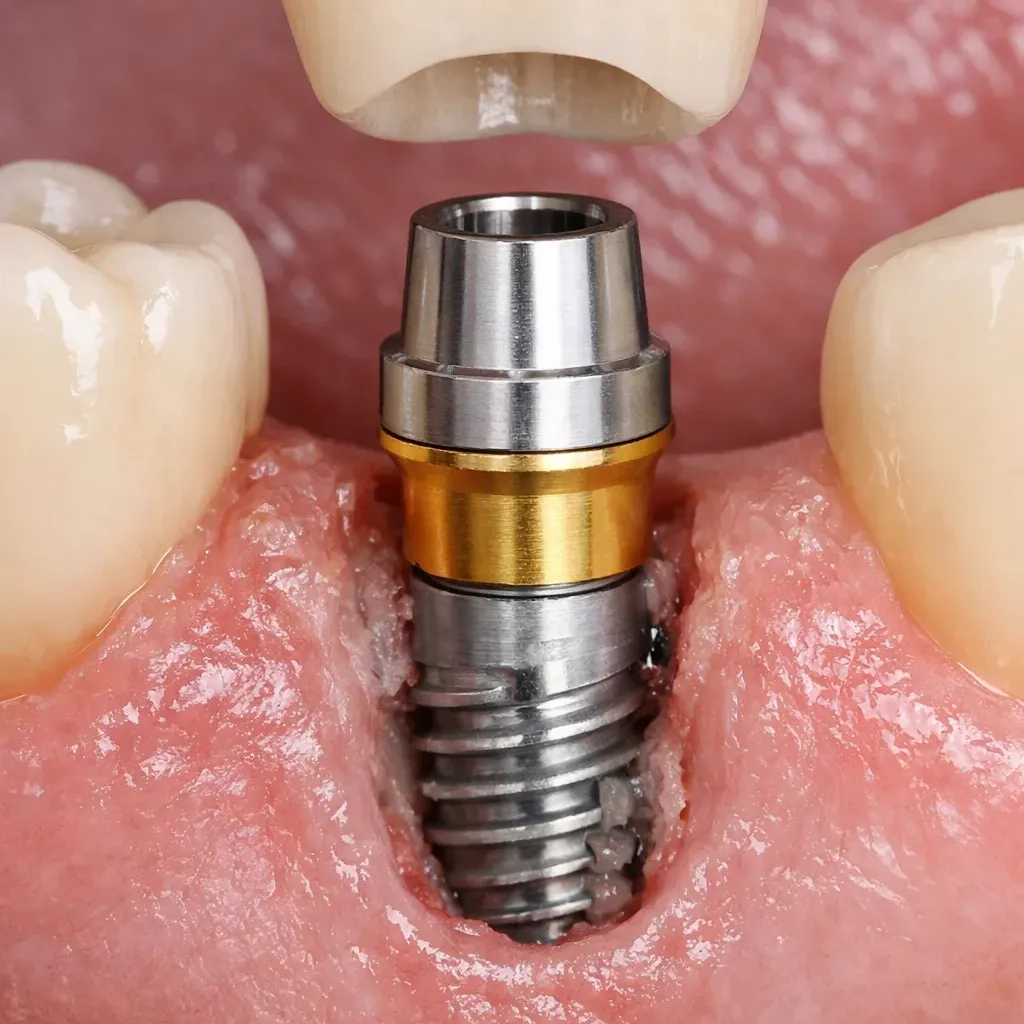
Anterior Implant Esthetics, Emergence Profile, and Tissue Stability with Dr. Jonathan Esquivel
A prosthodontic discussion on restoring implants in the esthetic zone, three-dimensional implant position, soft tissue grafting, provisional design, ridge dimensional changes, and the framework of space, volume, and time.
The Esthetic-Zone Implant Is a Test of Biology, Prosthetics, and Patience
Anterior implant esthetics are not created by the crown alone. They emerge from the interaction between implant position, bone volume, soft tissue phenotype, provisional design, emergence profile, patient hygiene, and time.
In this episode of the Dental Digest Podcast, Dr. Melissa Seibert speaks with Dr. Jonathan Esquivel about the clinical difficulty of restoring implants in the anterior esthetic zone.
Dr. Esquivel frames the discussion around three essential concepts: space, volume, and time. Space refers to the prosthetic and biologic room needed to design the implant restoration properly. Volume refers to the hard- and soft-tissue foundation required to support esthetics and health. Time refers to the biologic maturation period needed before the final restoration is completed.
The episode also emphasizes a restorative principle that is easy to intellectually accept but difficult to execute: the provisional phase is not optional in high-level anterior implant dentistry. The provisional restoration helps guide tissue healing, test emergence profile, communicate subgingival contours to the laboratory, and reduce the risk of discovering tissue change only after the final crown has been delivered.
Why the Anterior Implant Requires Reverse Engineering
Implants Are Not Roots
Dr. Esquivel begins by identifying the central biologic problem: an implant is not a natural root. Teeth have a periodontal ligament, bundle bone, proprioception, and a biologic attachment apparatus that gives peri-dental tissues resilience. Implants lack many of those biologic advantages, so the surrounding tissue response is less forgiving.
This is why esthetic-zone implants require what he describes as being “double or triple careful.” Even small changes in tissue level, papilla height, emergence contour, or facial volume can become visible in the anterior maxilla.
Three-Dimensional Implant Position Dictates the Restoration
The episode strongly reinforces restorative-driven planning. Before deciding where the implant should go, the clinician must determine where the tooth should be. Incisal edge position, cingulum position, facial contour, and symmetry must be established before implant placement.
In an ideal anterior implant position, Dr. Esquivel describes the implant platform as approximately 4 mm apical to the planned tooth position and emerging closer to the cingulum. That position helps preserve restorative room for the abutment, emergence profile, and soft tissue architecture.
Adjacent Implants Raise the Esthetic Difficulty
Adjacent implants, especially in the anterior zone, create additional esthetic challenges because papilla formation between implants is less predictable than papilla formation between a tooth and an implant. The clinician must consider whether the missing teeth are two centrals, a central and lateral, or another combination that will be compared visually with the contralateral side.
Dr. Esquivel emphasizes symmetry as a fundamental esthetic requirement. When adjacent implants create asymmetry, shortened papillae, or visible tissue discrepancies, the result can be difficult to disguise.
Soft Tissue Grafting Supports Both Esthetics and Biology
The conversation then turns to tissue volume. Dr. Esquivel distinguishes between margin preservation therapies, where the clinician is trying to preserve an acceptable existing tissue outline, and margin reestablishment therapies, where vertical and horizontal tissue dimensions have already been lost.
In many esthetic-zone implant cases, connective tissue grafting can improve soft tissue thickness, mask restorative materials, support margin stability, and reduce recession risk. Dr. Esquivel does not claim every case needs grafting, but he argues that most esthetic-zone cases benefit from thoughtful soft tissue augmentation unless the patient already has an ideal thick phenotype and stable tissue architecture.
Extraction Changes the Ridge
The episode highlights a clinical truth that patients often underestimate: once the tooth is removed, ridge remodeling begins. Loss of the root and periodontal ligament leads to loss of bundle bone and subsequent hard- and soft-tissue dimensional changes.
Dr. Esquivel explains that what happens during the interim period matters. A patient may not be ready for an implant immediately because of finances, biology, or emotional timing, but the provisional strategy can either protect the site or accelerate tissue change.
Provisional Design Can Preserve or Damage the Site
Removable provisional partial dentures can be problematic when they lack rest seats and transfer vertical load into the healing ridge. This pressure can accelerate remodeling of residual hard and soft tissues. An Essix retainer or properly relieved provisional option may be more protective if kept off the healing site.
The key is not simply giving the patient something that looks acceptable. The key is giving the tissue the correct space, avoiding pressure, and respecting healing time.
The Provisional Phase Is a Mandatory Design Step
Dr. Esquivel’s strongest restorative point is that the provisional restoration is not merely a cosmetic placeholder. It is a biologic and communication device. It guides tissue healing, allows tissue creep into embrasure spaces, tests emergence profile design, and gives the ceramist information about the subgingival architecture.
If the clinician skips this step, the laboratory may be forced to design subgingival contours arbitrarily from a stone model or digital implant platform. Dr. Esquivel argues that the restorative dentist should own the transition between pink and white esthetics, rather than outsourcing the entire subgingival contour decision to the ceramist.
Clinical Takeaways
- Anterior implants are uniquely unforgiving: Small tissue changes in the esthetic zone can create visible asymmetry, recession, papillary defects, or unaesthetic emergence.
- Implants must be reverse engineered: The tooth position, incisal edge, cingulum, and facial contour should be determined before implant placement.
- 3D implant position drives emergence profile: Implant platform depth and facial-lingual position influence abutment selection, crown contour, cleansability, and esthetics.
- Adjacent implants are more challenging: Papilla formation and symmetry are more difficult to control between adjacent implants than around a single implant adjacent to natural teeth.
- Soft tissue volume matters: Connective tissue grafting can improve margin stability, help mask materials, reduce recession risk, and support long-term esthetic outcomes.
- Extraction changes the ridge: Loss of the root and periodontal ligament initiates hard- and soft-tissue dimensional changes that must be anticipated.
- Provisionals are biologic tools: A provisional can guide tissue healing, allow tissue maturation, shape emergence profile, and communicate subgingival design to the ceramist.
- Space, volume, and time are central: Predictable anterior implant esthetics require adequate restorative space, adequate hard and soft tissue volume, and adequate time for maturation.
Key Questions This Episode Helps Answer
Why are anterior implants so difficult to restore esthetically?
Anterior implants are difficult because the tissues are visible, dynamic, and less forgiving around implants than around natural teeth. Implant position, tissue volume, emergence profile, and patient hygiene all affect the final esthetic result.
Where should an anterior implant be positioned?
Dr. Esquivel emphasizes reverse engineering from the desired tooth position. Ideally, the implant platform should be positioned with enough apical and palatal restorative room to develop a natural emergence profile, often described around 4 mm apical to the planned tooth reference point and closer to the cingulum.
Why are adjacent implants challenging in the esthetic zone?
Adjacent implants are challenging because the interimplant papilla and symmetry are difficult to control. Tissue height between two implants is less predictable than tissue height between a tooth and an implant.
When is connective tissue grafting useful around implants?
Connective tissue grafting is useful when additional tissue thickness is needed to support esthetics, mask restorative materials, improve margin stability, and reduce recession risk. It is especially important in margin reestablishment cases where tissue volume has already been lost.
What happens to the ridge after tooth extraction?
After extraction, loss of the root and periodontal ligament leads to loss of bundle bone and hard- and soft-tissue dimensional changes. These changes are most pronounced early but can continue over time.
Why is provisionalization important for anterior implant dentistry?
The provisional restoration helps shape tissue healing, test emergence profile, allow tissue creep, protect the mucosal seal, and provide the laboratory with information about the subgingival contours of the definitive restoration.
Chapters & Timestamps
| Timestamp | Topic Covered in Episode |
|---|---|
| [00:00] | Injection Molding Guide and Dental Digest Introduction |
| [03:00] | Why Anterior Implants Are the Ultimate Restorative Test |
| [06:00] | Anatomical and Biological Challenges in the Esthetic Zone |
| [10:00] | Space, Volume, and Time as Implant Esthetic Principles |
| [13:00] | Three-Dimensional Implant Position and Emergence Profile |
| [18:00] | Adjacent Implants and the Challenge of Symmetry |
| [25:00] | Soft Tissue Grafting, Margin Preservation, and Margin Reestablishment |
| [33:00] | Ridge Dimensional Changes After Tooth Extraction |
| [39:00] | Essix Retainers, Flippers, and Provisional RPD Design |
| [46:00] | Why the Provisional Stage Is Mandatory |
Dr. Jonathan Esquivel
Prosthodontist · Implant Esthetics · Biologically Driven Restorative Dentistry
Dr. Jonathan Esquivel is a prosthodontist in private practice who completed his specialty training at LSU School of Dentistry in 2013, followed by an esthetic and implant fellowship in 2014. A former LSU faculty member, he has received multiple teaching honors, including the Golden Apple Award, the Dr. Allen A. Copping Award for Excellence in Teaching, and the 2023 Claude Baker Award from the American Academy of Fixed Prosthodontics.
Learn with Elevated GP
Dr. Melissa Seibert
DMD, MS, FAGD, ABGD
Dr. Melissa Seibert is the creator and host of the Dental Digest Podcast, a clinical dental podcast dedicated to helping dentists stay on the cutting edge of evidence-based dentistry. She is a clinician, educator, speaker, and founder of Elevated GP, a virtual study club and advanced education community for general dentists who want to become exceptional comprehensive clinicians.
Publications & SpeakingBuild the Judgment Behind Beautiful Implant Restorations
Dental Digest introduces you to the ideas shaping modern dentistry. Elevated GP helps you turn those ideas into clinical judgment through live CE, case-based mentorship, on-demand education, and a community of dentists committed to evidence-based excellence.
Explore Elevated GPStudies & Resources
- Chappuis, V., Araújo, M. G., & Buser, D. Bone response after immediate placement of implants in the anterior maxilla: a systematic review. International Journal of Oral & Maxillofacial Implants. PubMed PMID: 30712238
- Chen, S. T., Buser, D. Esthetic outcomes following immediate and early implant placement in the anterior maxilla: a systematic review. International Journal of Oral & Maxillofacial Implants. PubMed Search
- Cosyn, J., et al. Immediate placement of dental implants in the esthetic zone: a systematic review and pooled analysis. Journal of Periodontology. PubMed PMID: 24502614
- Tan, W. L., Wong, T. L. T., Wong, M. C. M., & Lang, N. P. A systematic review of post-extractional alveolar hard and soft tissue dimensional changes in humans. Clinical Oral Implants Research. PubMed PMID: 22211303
- Lee, C. T., Chiu, T. S., & Chuang, S. K. The effect of soft tissue augmentation on the clinical and radiographical outcomes following immediate implant placement and provisionalization: a systematic review and meta-analysis. International Journal of Oral & Maxillofacial Implants. PubMed PMID: 34435229
- Systematic Review of Soft Tissue Alterations and Esthetic Outcomes Following Immediate Implant Placement and Restoration of Single Implants in the Anterior Maxilla. PubMed PMID: 26313019
- Dimensional changes after immediate implant placement with or without simultaneous regenerative procedures: a systematic review and meta-analysis. PubMed PMID: 26073267
- Emergence profile management in the esthetic zone. PubMed PMID: 39072695
Full Episode Transcript
Dr. Melissa Seibert: Hey, I want to tell you about something I put together for you. I created a free PDF guide that walks you step-by-step through the injection molding technique. I love this technique because it is one of the best ways to get predictable, beautiful, and highly aesthetic anterior composites.
You're actually injecting the composite directly into the tooth using a clear template, which makes it far more consistent and efficient. If you like this guide, I've made it super easy. Just head over to theelevatedgp.com forward slash IMPDF.
And to make it even simpler, I've included the link for you right here in the show notes.
Hey, welcome to Dental Digest. I'm your host, Dr. Melissa Seibert, and this is a podcast with a mission of enabling you to stay on the cutting edge of evidence-based dentistry.
This is part one of a two-part series with Dr. Jonathan Esquivel, a prosthodontist and educator known for his work in implant aesthetics and biologically driven restorative dentistry. In this first episode, we'll dive into the challenges of restoring implants in the aesthetic zone, where even the smallest variations in tissue or bone can have a huge impact on long-term results.
Dr. Esquivel shares his framework of space, volume, and time, and how it can help clinicians achieve predictability in complex aesthetic cases.
Dr. Jonathan Esquivel is a prosthodontist in private practice who completed his specialty training at LSU School of Dentistry in 2013, followed by an aesthetic and implant fellowship in 2014. A former LSU faculty member, he's been recognized with multiple teaching honors, including the Golden Apple Award, the Dr. Allen A. Copping Award for Excellence in Teaching, and the 2023 Claude Baker Award from the American Academy of Fixed Prosthodontics.
Widely published and an invited national and international speaker, Dr. Esquivel is passionate about advancing prosthodontics while delivering individualized, aesthetically driven care at the highest level.
I've got something that you're going to love. If you've been loving the podcast and want to dive deeper into mastering implant dentistry, this is your chance.
I'm giving away access to one of my on-demand courses completely free. This course is packed with everything you need to know about implant occlusion, platform switching, and creating that stunning aesthetic emergence profile that sets your work apart. Here's how to grab it.
Leave a rating for the podcast, take a quick screenshot, and send it my way. You can either direct message me on Instagram. My Instagram handle is Dr. Melissa Seibert. Or send it to me in an email at dr.melissaseibert at gmail.com. Once I get the screenshot, I will send you access to the course so you can start learning right away.
It's my way of saying thank you for supporting the podcast and being part of this amazing community, and I can't wait to hear what you think.
Dr. Melissa Seibert: So why is restoring a single implant in the anterior aesthetic zone often considered the ultimate test of restorative dentistry?
Dr. Jonathan Esquivel: I think that the bigger difference or the biggest challenge in restoring a single implant or an implant in the aesthetic sector is twofold. The first one is, of course, trying to achieve that natural look with tissues that are constantly changing, or in constant change.
And the second one is dealing with a device that is not a root and does not have the same biological protection or the biological assets that a root has. Achieving that balance between an aesthetically pleasing restoration and a biologically stable restoration is a challenge because of that.
It's two different beasts. Tissues around teeth are so resilient. Not so much around implants. This is why for us as dentists, we really have to be double or triple careful when we're dealing with an implant restoration per se.
Dr. Melissa Seibert: What are the key biological and anatomical factors that make the anterior zone so difficult compared to the posterior? This is just so important because so often we think if you can comfortably restore a mandibular molar, you can restore anything, and that's just not the case. There's a lot of thoughtfulness that goes into restoring implants in the anterior aesthetic zone.
Dr. Jonathan Esquivel: I think that some of the things that we have to consider is, one, the anatomical position of the bone. In your anterior maxilla, you have that naturally tilted anatomy, that natural inclination of the maxillary arch, that already sets you at a little disadvantage when it comes to your prosthetic design.
I always like to say that the three most important things are always space, volume, and time. If that implant is misplaced in the aesthetic sector and you start violating the space requirement, that is going to alter, for example, your material selection for your abutment. It's going to alter the shape of your emergence profile.
I was asked a couple of weeks ago by one of the colleagues I work with, “Jonathan, what do you think are some of the most important things to have long-term success in implant therapy?” And I said, “I'm going to talk to you about four.”
The first one was luck, because in an implant, there's a lot of factors that we can't control: the human response, the biological response, the innate response of the patient, your patient's behavior, and all the other things that you cannot see that you try to control through proper management of the implant placement, proper management of the abutment design, et cetera.
But in reality, you're limited to some degree. The second important thing for me was three-dimensional position of the implants, because that's going to directly dictate your emergence profile design. The third one is emergence profile. The fourth one would be the patient's capacity to clean and the patient's capacity to maintain this environment.
This is why it's so hard. We're dealing with an evolving or changing set of tissues in an aesthetically demanding area of the mouth, in which the minor changes that happen to the tissues are going to be so easily seen. Not only that, we're dealing with smaller dimensions of bone, and as this bone changes, we're leaving those implants in a not-so-favorable position compared to the posterior.
Dr. Melissa Seibert: Can you please describe where the implants should be placed so that we can achieve the most aesthetic outcome, versus where the implant might be placed where we're facing a lot of aesthetic challenges?
Dr. Jonathan Esquivel: That's a very good question. A couple of years ago, I wrote an article that was called The Impact of the Three-Dimensional Position of the Implant and Emergence Profile Design, and this is directly linked to aesthetics too.
I think the first thing that we need to think about is that every single case that we do in implant dentistry has to be reverse engineered. For me to answer that question, first I need to know where the tooth is supposed to be, and I have to have a proper position of the tooth.
Once I have that incisal edge, that cingulum point rather, I want to have the platform of that implant about four millimeters apical to that. In an ideal situation, I want to have that platform of the implant not only four millimeters apical, but emerging closer to the cingulum of the tooth.
For that to happen, you need a plethora of things. You need good volume of bone, good volume of tissues, and also a proper environment with the neighboring teeth too. One of the things that's important to consider in anterior implants is not only the position of the implant's neck or the implant's platform, but also the surrounding structures.
How is the crest of the bone maintained by the neighboring teeth? Are we placing two implants side by side? How is this going to affect my aesthetic outcome? What implants are we replacing side by side? Am I dealing with a central implant and another central incisor implant, or am I dealing with a central incisor and a missing lateral incisor?
One of my very best friends, whom I consider one of my mentors, has a beautiful quote that says, “We oftentimes spend too much effort trying to learn the complex when the basis of excellence is to master the basics.”
Going back to this and taking this phrase and putting it into what you just asked me, for me, the most important thing to consider when placing an implant in the three-dimensional position is to position that tooth first in the right three-dimensional position. If I have to move neighboring teeth around with orthodontics, if I have to do periodontal surgery around, I'll do it.
That's going to set the tone for that proper position on the implant, not the physical act of just putting a screw in the bone, essentially.
Dr. Melissa Seibert: What are the challenges when you are restoring adjacent implants?
Dr. Jonathan Esquivel: There's quite a few. Going back to that quote I just said, we have to think about the aesthetic basics or aesthetic fundamentals. For me, the most important fundamental in the anterior sector is to achieve symmetry.
Depending on where I'm restoring these adjacent implants, the bigger challenge between two adjacent implants is to have beautiful soft tissue between them, a nice papilla between the two implants. It's not the same to have a shortened papilla between two centrals as having a short papilla between a central and a lateral where I can compare to the contralateral side.
That becomes a challenge because you're then playing with symmetry, which is, like I said, one of the most important fundamentals. If you ask me, that's the number one task. That's the hardest thing to achieve: to have a symmetrical outcome.
If I have the two centrals, I'm a little bit less worried. Nevertheless, I want to achieve a good aesthetic outcome. The bigger challenge is maintaining what I have achieved in time because I know these tissues are going to change.
We try to sometimes overcompensate the soft tissue with soft tissue grafting. Many times, in situations where we need orthodontic extrusion, we orthodontically extrude teeth before placing implants to have a vertical overcompensation and position the bone and the crest of the bone where we want them to be.
A lot of things have to come into play for us to be able to get this outcome to be what we want. That's the bigger challenge: finding the patient, one, that is willing to go through all this process; two, that understands that we're in a limitation when we place an implant to get these perfect outcomes; and three, that is also willing to undergo additional procedures like orthodontics many times or tissue grafting and taking a little bit of the palate, a little bit of the tuberosity, and putting it in these future implant sites.
Dr. Melissa Seibert: Let me ask you something. When you graduated dental school, did you imagine yourself taking on advanced challenging cases and doing the kind of dentistry that excites you on your commute into work? Advanced endo, implants, aesthetic cases, et cetera? Or do you find yourself stuck in dentistry that feels repetitive, boring, confusing, and maybe even unfulfilling?
Are you frustrated by unpredictable failures, crowns debonding, patients unhappy, and not even sure why it's happening? Today, are you the dentist that you want to be?
Now imagine becoming the exceptional comprehensive dentist you always wanted to be. The kind of dentist who practices with clarity, confidence, and consistency, who thinks beyond bread and butter procedures. They're respected, referred to, and fulfilled because the work is both meaningful and challenging.
That's what we build inside of Elevated GP. We build exceptional comprehensive dentists who step into the clinical version of themselves they've always wanted to become.
Inside our program, you will find live CE lectures every month that cover the topics our community wants most, from implants to occlusion to treatment planning to anterior composites. We also have monthly live Q&A sessions where we tackle your toughest cases together, teaching you not just what to do, but how to think.
We also have an exclusive community where you can bring your real clinical challenges and get thoughtful, evidence-based answers without the noise of a random Facebook group.
I believe that iron sharpens iron. You are the average of the people you surround yourself with. So come join a community where dentists push each other to the highest level.
If this resonates, I want to invite you personally to head over to TheElevatedGP.com and become one of us.
Dr. Melissa Seibert: Can you speak about when soft tissue grafting is utilized? How important is soft tissue for achieving a really good aesthetic outcome with the implant? I think that there's a lot of healthy discussion going on about this over the course of the last five years, and we've really recognized the importance of really good healthy soft tissue.
Dr. Jonathan Esquivel: Absolutely. When we started talking just a few minutes ago, we talked about three fundamentals that I said are critical. We talked about space and how the 3D position of the implant, emergence profile design, and material selection are three things that influence this.
The second fundamental is volume. We need to have a good volume of tissues, bone, and soft tissue. Depending on the case, we're going to need more or less of that additional grafting procedure.
We like to divide the treatments into margin preservation therapies and margin reestablishment therapies. In a margin preservation therapy, the name is very descriptive. You want to maintain the existing soft tissue outline.
In many of these cases, which is a typical patient that comes to your practice and needs a tooth extracted, immediate implant placement, immediate provisionalization, if this patient has a thick phenotype, if this patient has thick bone, many times you may say, “In this particular case, I may not need a connective tissue graft.”
But this is not the norm. Many or a lot of the patients that come to our practice do not have a perfect soft tissue outline or very thick phenotype. Oftentimes, they will benefit from soft tissue grafting. This is for many reasons, biological and aesthetic reasons.
From the aesthetic standpoint, the fact that I have thicker tissues gives me more margin stability in time. It allows me to mask dental materials that I'm going to use in this future implant site or future implant site. And from the biological standpoint, less chance of recession.
Also, the association of thicker tissues and more stability of the bone crest, and the association of soft tissue grafted sites and the dimensions of that ridge after the tooth has been extracted, the implant has been placed, and the tissues mature.
In my opinion, most of the cases in the aesthetic sector benefit from a connective tissue graft. We cannot say all because there are situations that won't need it, like very thick phenotypes and ideal soft tissue outlines with thick phenotype associated with it. But that's not the vast majority of cases.
Now, if we're talking about margin reestablishment therapies where your patients have lost vertical and horizontal soft tissues, in those cases, I think it's almost an absolute must to have a connective tissue graft associated, not only the bone regeneration done.
Dr. Melissa Seibert: You talked about the ridge stability after extraction, and this isn't talked about enough. What happens to the bone after we take a tooth out? Sometimes patients will not want to go through extensive restorative treatment, and so they'll say, go ahead and just take the tooth out. But you're largely a part of creating a really aesthetic outcome. Can you comment a little bit more about what it is about tooth loss that leads to a lot of ridge instability?
Dr. Jonathan Esquivel: Essentially, if you go back and read the literature about what happens or what percentage of sites get resorption, it's pretty interesting. Don't ask me to quote you the authors right now, but some authors talk about sites that have extraction are highly associated with ridge dimensional changes.
In sites that these dimensional changes happen, they tend to be what we classify as severe, with a vertical and a horizontal component, which makes it really, really tough. You've lost that root. You've lost that PDL. The moment you extract the tooth, the bundle bone goes away. There's a series of biological changes that are happening in the sites that need to be addressed.
One of the things I'd like to emphasize is you're going to have patients that are not going to be ready to get an implant immediately for many reasons: financial, biological, or simply they're not emotionally ready, which is one of the bigger things.
What we do in that site in the meantime will help diminish or alleviate the rate at which these changes happen, or will cause them to move faster into those dimensional changes. What I refer to here is provisionalizing the sites.
One of the things that I like to emphasize is to tell dentists that flippers may not be the best resource for that future implant site. Yes, they're easy to do. Yes, they look much nicer than an Essix and your patients are going to be happier with you. But the problem is that they may be causing or exacerbating or accelerating the rate at which these dimensional changes happen on both the hard and soft tissue.
Before, I used to do a lot of Maryland bridges. I don't do many anymore. I do a lot of Essix retainers now because of time and cost and all that stuff. But I think they serve a purpose, which is not to accelerate my bone and tissue dimensional changes because we know that they will happen to some degree.
It will happen to most people. The literature says that 91% of the sites with dimensional changes are associated with that extraction too. It's very, very important that we as dentists take note of this.
I'm not a surgeon. I'm a restorative dentist. My task as a restorative dentist that today does not do any surgery is to try to prevent how fast these tissues change.
Dr. Melissa Seibert: Talk a little bit more about why an Essix-type option or even a provisional RPD might not be the greatest thing for the hard and soft tissue.
Dr. Jonathan Esquivel: I think Essix retainers are not a problem. I do a lot of Essix, to be honest with you.
A provisional RPD is a problem because they don't have any rest seats. It's not like a regular RPD where you have built-in rest seats in your teeth that are going to get that vertical load when you bite down. The problem with the RPD is you bite down and the pressure of that interim partial is going to be extrapolated to the residual tissues.
That's going to make this remodeling happen much faster. On an Essix, in a properly done Essix, as long as you keep it off the tissues, it should be just fine.
Of course, it really depends what situation you have too. If I have a patient that gets a tooth extracted and gets a bone graft and a large connective tissue graft done, I always tell my patients, “My first Essix is going to be ugly. It's going to be really short. I don't want anything touching these tissues. Then I can make you something that looks prettier.”
I know that's not what patients want to hear many times or most of the time. Nobody wants to go around life with a short tooth that does not look nice. But I try to build the importance into these patients of time, letting tissues heal.
This would be our third important principle: space, volume, and time. We have to let those tissues heal, whether it is in the initial stages after extraction and grafting, if you replace the implant, or if you place them in an outloader, or even after you've provisionalized that implant. Let those tissues heal. Give them the right amount of space and patience.
All of these little things that we do are going to protect the tissue and bone from a faster deterioration or from deterioration caused by our prosthetic designs in our interim restorations or our final restorations.
Dr. Melissa Seibert: I love that you mentioned this. Todd Schoenbaum, I know he's your good friend. You both have immense respect for one another. He talks about how the provisional stage is not optional. It's a mandatory part of the procedure and it's integral to the long-term success. Can you speak a little bit more about why this is? Because it is hard to prepare patients for this.
Dr. Jonathan Esquivel: Absolutely. Think about the moment you extract the tooth. Most of the dimensional changes are going to happen within the first three to six months according to the literature. However, they can happen within the first year.
Let's think about this from a logical standpoint. Where do you want these dimensional changes to happen? In the interim restoration, where you can still modify and make changes, or in the final restoration, where once you've delivered it, if some change happens, you have to redo it again?
That's from the business standpoint and from the patient comfort standpoint. From the biological standpoint, we have to think and understand that a lot of these tissues take a lot of time to heal. I want to give these tissues the proper environment. I want to guide their healing.
A lot of people envision an immediate provisional on a post-extraction socket as an aesthetic benefit because you maintain the soft tissue outline, the papilla, et cetera. I also envision it as a biological advantage because I am maintaining or preserving the existing aesthetics, but I'm letting the tissue heal around the proper anatomy.
Once these tissues heal, if everything is proper and correct, all I have to do is disconnect this crown once from the patient's mouth, put in an impression coping or scan body, scan, and put my provisional back on. If I'm lucky and I have a great ceramist, next appointment I'm delivering a crown.
This little amount of disconnections is a great biological advantage for the site because I'm maintaining, or at least not disturbing, that very weak mucosal seal constantly. That's the biological purpose.
Second, once we extract the tooth and put a provisional in, many times you're going to see that the tissues are going to change. You're going to have maybe little black triangles every now and then. If you let these tissues heal, and in many occasions the crest of the bone is at the right level, you're going to see the soft tissue creep into these spaces and stabilize itself following the anatomy of the restoration you've given previously.
What happens if we move fast? I have a friend from Brazil who gave this a name. We call it a restorative curse. If we see a little space in our mind, the first thing we want to do is block it and close it with ceramic or close it with plastic or something. But if we do that, we're not letting those tissues creep into these spaces.
You don't want to take on that challenge. You don't want to take on that risk of those tissues not moving into these spaces in your final restoration. You want to take them into the provisional restoration, let them creep, let them move into these spaces. If they don't after some long period of time, then you know that they're probably going to stay there, and then you can move to your final.
The other thing is when I'm restoring the aesthetic sector, I need to give information to my lab technician. If I establish my parameters adequately, if I give this beautiful soft tissue outline, but also manage the subgingival spaces with a biologically thought-of process, then I can extrapolate this information to the ceramist to turn this into a titanium or zirconia abutment and a ceramic crown.
For me, this is just a personal opinion. I don't want to give all the responsibility to my ceramist to design what's under the gums, under that free gingival margin.
The number one task of the ceramist is to make that crown look beautiful. That's why I believe that we should not take credit for the white because we don't do the white. I, as a dentist, as a restorative dentist, should take credit for the transition between the pink and the white and the stability of that tissue and how we design the emergence profile.
But if I don't provisionalize my cases, then my laboratory is going to have to do this, and they're going to have to do it somewhat in an arbitrary mode because they don't have the patient in front of them. They just have either a stone model with a platform of an analog or an STL file that has a digital platform of the implant that comes from the scan made with a scan body.
Dr. Melissa Seibert: If you're the kind of person who's passionate about excellence and who thrives on connection and who knows that being in the room with the right people can change everything, this is your invitation.
Elevated GP is hosting its very first live in-person meeting. It's happening April 10th and 11th in Denver, Colorado. Two days, hands-on, high touch.
This isn't just another conference. This is a masterclass experience designed for dentists like you, people who are committed to sharpening their skills and elevating their craft.
I'm going to be teaching a whole day-long course and hands-on course on ceramic onlays, overlays, and veneer lays. Then we are bringing in the best of the best. Bob Margeas is going to be teaching a hands-on Class IV course in a way that is going to completely transform your approach to these cases.
My mentor, Dr. Mark Latta, the former dean of Creighton, is going to be teaching a masterclass in adhesion that is going to blow your mind. As a bonus, we're going to be diving into minimally invasive dentistry because innovation is what sets us apart.
Here's the thing: this isn't just about the skills. It's about the people too. In a post-COVID world, we're all realizing how much we crave real connection.
This is your chance to build your network, to be in the room with peers who are just as passionate, just as driven, and just as committed to growth as you are. Iron sharpens iron, and this is where it all happens.
Now for those of you who know you're ready, who don't need convincing, there's early bird pricing available until Christmas. This is our way of celebrating action takers, the ones who know this is for them.
Seats are limited, and this is going to fill up fast. So if you're ready to be a part of something truly transformative, head over to theelevatedgp.com and grab your spot. I've also included a link to it in the show notes.
Let's make April a game changer for your practice, your career, and your community. And I can't wait to see you there. Again, to get registered, go to theelevatedgp.com forward slash elevation summit.