
The Orthopedic TMJ Blueprint: Custom Joints, Airway Collapse, and 3D Red Flags
How replacing a single crown can trigger hidden jaw pain, why unaddressed joints ruin orthodontic cases, and a step-by-step 3D checklist to scan for bone loss.
The Hidden Loading Trap in Your Everyday Restorations
We have all had it happen. You place a beautiful new crown, check the bite, and send the patient home. A few days later, they call back furious because their jaw is suddenly throbbing. It is easy to think you did something wrong, but you didn't create the problem—you just woke up a sleeping giant.
Our patients are incredibly good at adapting to slow, quiet joint damage over time. They can walk around for years with a torn jaw ligament or bone grinding on bone without feeling a thing. But when you change the shape of a single tooth, you change the way weight is distributed inside the jaw joint. That tiny adjustment shifts the load, breaks their fragile adaptation, and triggers immediate pain.
As general dentists, we cannot keep playing hot potato with jaw joints. Legendary educators like Pete Dawson proved that true joint stability is the actual secret to making your dental work last forever. By learning how to spot the warning signs of joint breakdown before you ever pick up a handpiece, you protect your patients from pain and save yourself from unfair blame.
Why Joints Crush Airways and How to Scan for Active Bone Loss
In this jaw masterclass, Dr. Scott Boulding joins host Dr. Melissa Seibert to share the exact orthopedic rules dentists need to monitor complex joint cases.
When the Jaw Slides Back: The Airway Connection
When severe arthritis eats away at the jaw bone, the patient loses condylar height. Think of it like a car tire slowly losing its air. As the bone breaks down and gets shorter, the entire lower jaw physically slips backward.
This structural slide directly compromises the patient's airway, making it harder for them to breathe. Dr. Boulding notes that this specific joint collapse is the hidden reason why massive numbers of orthodontic and jaw alignment surgeries fail and have to be completely redone every year.If you do not stabilize the foundation of the joint first, any alignment work you do on the teeth will eventually crumble.
The Power of Custom Joints over Lifetime Drugs
For patients facing severe, non-repairable joint destruction, modern surgery relies on total joint replacements. While some doctors try to manage these cases using a lifetime routine of anti-inflammatory drugs and perfect bites, it requires intense patient compliance.
Instead, following the data-driven orthopedic models used for knees and hips offers a permanent fix. Using 36 years of excellent safety data, surgeons now build custom artificial joints designed for the patient's exact anatomy. These custom parts allow the surgeon to physically pull the lower jaw forward, opening up the breathing path and giving the patient long-term predictability without lifetime medications.
The General Dentist’s 3D Scan Checklist
You cannot see joint tissues or active bone breakdown on standard biting x-rays. Even a flat panoramic film is a very tough screening tool. If a patient shows severe tooth wear, crowding, or sudden bite shifts, you must look closer by taking a 3D Cone-Beam scan (CBCT).
When checking a 3D scan, use Dr. Boulding's clear checklist across two views:
- The Front View (AP): Look at the top of the condyle. It should look like a smooth, harmonious circle. If you see flattening on the outer edge, sharp bone spurs (osteophytes), or hollow bone cysts, the joint is actively degenerating.
- The Side View (Lateral): Look for condylar beaking. A sharp, beak-like point on the bone means the muscle is pulling hard against a broken joint.
- The Joint Space: Check the gap between the jaw bone and the skull. If there is zero space, the protective disc has slipped completely out of place, leaving the joint bone-on-bone.
Clinical Takeaways
- Spot the Crowning Trap: Realize that changing a single crown alters load distribution, which can instantly wake up a silent, pre-existing jaw joint issue.
- Use the CBCT Checklist: Move past flat panoramic x-rays and use 3D scans to check for flat condyles, bone spurs, and hollow bone cysts.
- Measure the Joint Space: Look for a narrow or missing gap between the condyle and skull, which proves the disc is displaced and damaged.
- Connect Joints to Airway: Remember that a loss of jaw bone height slides the mandible backward, directly crushing the patient's breathing path.
- Stop Orthodontic Redos: Build perfect joint stability before starting massive alignment cases so you do not land in the failure loop.
Chapters & Timestamps
| Timestamp | Topic Covered in Episode |
|---|---|
| [00:00] | Introduction and the Free Step-by-Step Injection Molding Technique PDF |
| [04:30] | The Punting Phenomenon: Why Dentistry Plays Hot Potato with TMJ Cases |
| [12:15] | The History of Jaw Splints and the Mid-80s Launch of Grainy Joint MRIs |
| [21:40] | The Dow Corning Disaster: How Falsified Research Stopped Insurance Coverage |
| [32:10] | The 40-Year Lag: Shifting General Practice Toward an Orthopedic Model |
| [41:55] | Waking the Giant: How New Crowns Displace Fragile Joint Adaptations |
| [49:15] | Custom Prosthetics vs. Lifetime Pills: Restoring Mandibular Height and Airway |
| [56:30] | The 3D Screening Checklist: Spotting Cysts, Spurs, and Missing Joint Space |
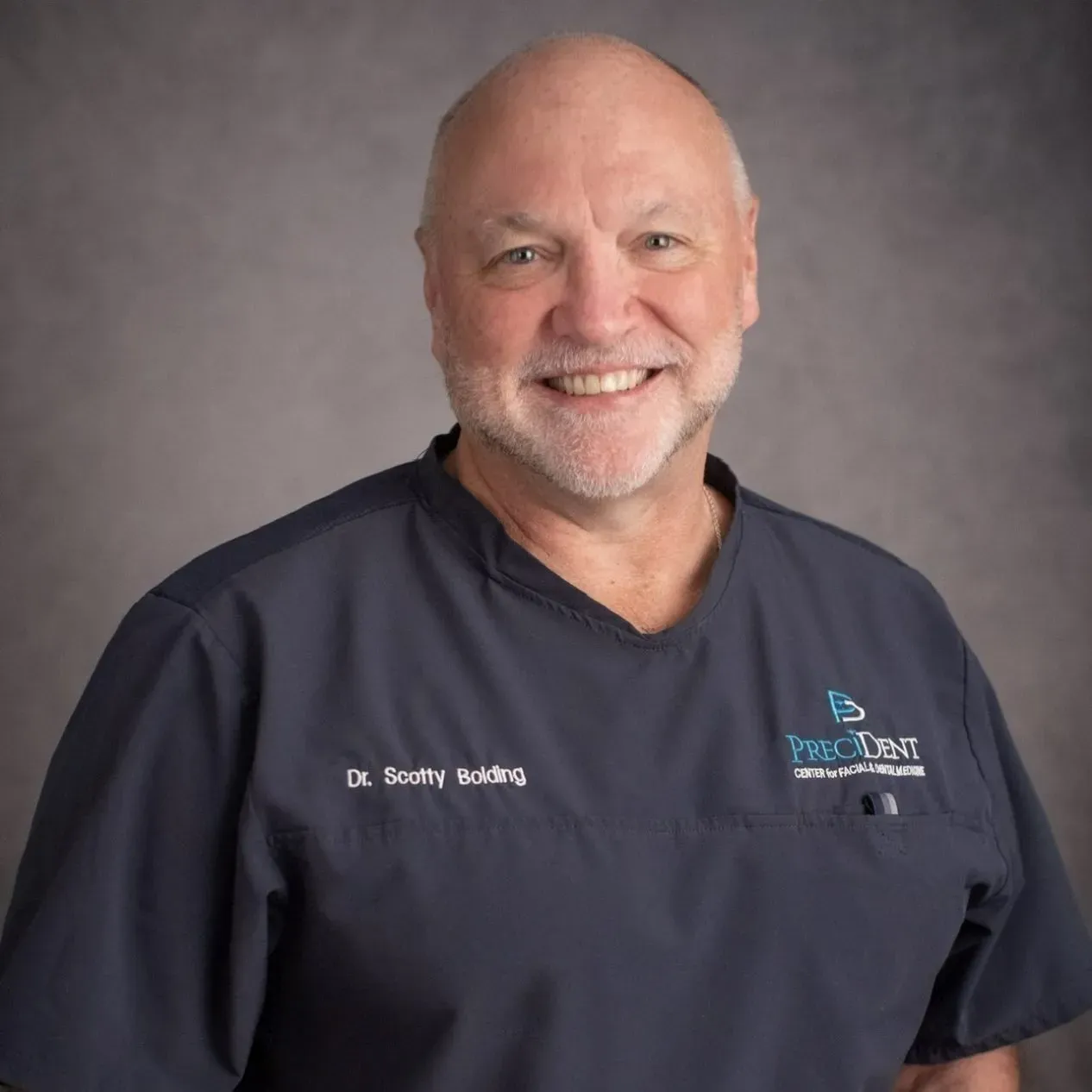
Dr. Scott Boulding
Oral & Maxillofacial Surgeon
An internationally recognized oral and maxillofacial surgeon celebrated for his advanced work in TMJ reconstruction, ligament repair, and custom total joint prosthetics. By championing a data-driven orthopedic approach backed by precise 3D imaging, his clinical protocols continue to rewrite the modern standard for surgical jaw care and complete patient wellness.
Surgical Practice Systems
Dr. Melissa Seibert
DMD, MS, FAGD, ABGD
Creator and host of the Dental Digest Podcast — the #1 clinical dental podcast worldwide and a top 1% global podcast. Dr. Seibert is a former active-duty U.S. Air Force dentist, internationally sought-after speaker, Key Opinion Leader, and published author in top dental journals. She is passionate about equipping general dentists with high-level, evidence-based clinical skills.
Publications & SpeakingMaster This Workflow in Your Practice
The Dental Digest Podcast brings you the theory — but Elevated GP gives you the over-the-shoulder execution. Step-by-step video masterclasses, clinical mentorship, and CE credit to implement these techniques seamlessly. Join our global community of dentists.
Explore the Elevated GP MembershipStudies & Resources
- Free Clinical Guide — Step-by-Step Anterior Injection Molding Technique
- The Elevation Summit — Live In-Person Masterclass Experience in Denver, Colorado (April 10-11)
- Free Occlusion Course Bonus — Rate the show, screenshot it, and email Dr. Seibert for free emergence profile training
- NIH Consensus Paper — Historical Guidelines on Surgical Jaw Restrictions
Full Episode Transcript
Dr. Melissa Seibert: Hey, I want to tell you about something I put together for you. I created a free PDF guide that walks you step by step through the injection molding technique. I love this technique because it is one of the best ways to get predictable, beautiful, and highly aesthetic anterior composites. You're actually injecting the composite directly into the tooth using a clear template which makes it far more consistent and efficient. If you like this guide, I've made it super easy. Just head over to theelevatedgp.com forward slash IMPDF. And to make it even simpler, I've included the link for you right here in the show notes.
Hey, welcome to Dental Digest. I'm your host, Dr. Melissa Seibert. This is a podcast with a mission of enabling you to stay on the cutting edge of evidence-based dentistry. This is part two of our two-part series. In case you missed last week's episode, I highly recommend you also listen to that. Joining me again today is Dr. Scott Boulding, an oral maxillofacial surgeon known for his pioneering work in TMJ reconstruction, ligament repair, and custom total joint prosthetics. His orthopedic-driven diagnostic approach, particularly his use of MRI, has helped redefine contemporary standards for TMJ management and surgical decision making. In this episode, we dive into the modern orthopedic framework for TMJ surgery, including how ligament injury leads to disc displacement and how MRI findings guide treatment. We also examine degenerative joint disease, radiographic red flags, when total joint replacement becomes indicated, and why unaddressed joint pathology often undermines orthodontic and orthognathic outcomes.
I've got something that you are going to love. If you've been loving the podcast and want to dive deeper into mastering implant dentistry, this is your chance. I'm giving away access to one of my on-demand courses completely free. This course is packed with everything you need to know about implant occlusion, platform switching, and creating that stunning aesthetic emergence profile that sets your work apart. Here's how to grab it. Leave a rating for the podcast, take a quick screenshot, and send it my way. You can either direct message me on Instagram, my Instagram handle is doctor.melissaseibert, or send it to me in an email at dr.melissaseibert at gmail.com. Once you get the screenshot, I will send you access to the course so you can start learning right away. It's my way of saying thank you for supporting the podcast and being part of this amazing community, and I can't wait to hear what you think.
Why do you think that we've been so dismissive as a medical community as a whole with the TM joint? Of course, physicians, this is really outside their wheelhouse that they're comfortable with, and us as dentists, I really feel like we play hot potato with TM joint patients where we really do this thing called punting where nobody really knows. So I'm not really referring you to a colleague that I feel very confident can manage this. I just want you out of my office. Why do you think that is? Do you think it's just really up until very recently? It's not that we didn't have the technology to evaluate it. I mean, MRIs have been around for quite a while. Where did this originate from? I think it's just very interesting because again, if a patient had an ACL tear, we wouldn't tell them to go to yoga and not chew gum, but that's what we oftentimes tell our TM joint patients.
Dr. Scott Boulding: That's a great question, and it has to do with some history. Melissa, I think you saw my lecture in San Antonio. So if you look back and you look at the TMJ and you look, say, in the 1900s up into the 2000s, we were seeing progression in terms of management. Occlusal management for the joint started in about the 1940s with Dr. Costen. Actually, he was an ENT, an otolaryngologist, which was very interesting. It was followed by some other physicians, and we started occlusal therapy really in the 50s and 60s. We started looking at splints and doing things to try to unload the joint, and we found that this gave some patients relief, not only in the joint, but some of the muscle pain that they were having as well. Then we started seeing the surgeries in the 70s and 80s. But remember, the MRI for the TMJ really didn't come out until the mid-80s. So the first MRI of the TMJ was probably mid to late 80s. It was a gentleman out of Baylor, Steve Harms, who actually did the first MRI of the TMJ. He's a friend of mine. Those first MRIs were very grainy. They weren't very, very good, but they've gotten a lot better.
But something else happened in the 80s that was disastrous for us as dentists, and that was in the 80s. There was a material created by Dow Corning. It was a disc replacement device called Proplast Teflon. Proplast Teflon was a material approved by the FDA on some falsified research, and this material caused severe breakdown in the TMJ. Remember, in the 80s, we didn't have managed care. We just had insurance, and so the insurance company would basically send physicians checks for whatever their bill was. We don't see that today at all.
Dr. Seibert: Wouldn't that be great, though?
Dr. Boulding: It would be, but that's gone. It's not going to happen again. It's not coming back. But so when we started having these problems, and we started, I mean, these were serious problems. They would have erosions into the middle cranial fossa, severe giant cell reactions, pain, swelling, and the surgeons would go in and try to take this material out, and they couldn't get it out because it granulated. So these patients had very, very chronic problems. The insurance industry stopped covering TMJ completely across the board in the United States. But when the medical insurance stopped covering TMJ, all of a sudden, surgeons stopped doing it. Patients now had to pay out of pocket if they needed it, but it pretty much became taboo. And then there was a consensus paper that came out of NIH because of basically the egg that the FDA had on their face from approving this all falsified research. And the consensus paper came out and said surgery at last resort, surgery at last resort. And some of these patients have more mental problems than they do physical problems, so you just need to treat it from a psychological standpoint.
And then we've had dentists that were doing the surgery stop doing the surgery. Then we had medical dental schools stop teaching really surgical procedures, stop training residents in surgery. And then all we had was occlusal management, but we really didn't know what we were doing because MRIs were not really in vogue at that time. And we've had probably 30 to 40 years behind. In the meantime, the orthopedic surgeons, which we were probably equal to them in that time frame, kept going and developing the techniques that they had with total joints and knee repairs. And we got left behind because we had such small numbers of surgeons paying attention to this joint. Therefore, dentists really don't get taught a lot about TMJ. You had your Gelbs and your Dawsons and your Pankey Institutes and your myelomonitoring folks, the people that were treating it, but that was all non-surgical management. And without an MRI or really good diagnosis, they were treating everyone the same. It was either a muscle problem or an occlusal problem. It could not be a surgical problem. And so I think that's a little bit of why we are where we're at today.
What we're trying to push for is more of an orthopedic approach, okay? Most of the problems can be treated by primary care dentists. Anti-inflammatories, occlusal issues, bite issues, muscle issues, that can be addressed non-surgically. And that follows the standard of care that they use with orthopedics. But if you have a tear or an anatomical problem that can't be resolved by those issues, then surgery should be considered. I do think though that we as dentists and comprehensive dentists need better training and better access to that training because we don't necessarily want the surgeon to be the only person managing it. We need someone that can help quarterback things and identify what are the medical means to treat it. And my concern is that there's this small bastion of professionals that understand management of the TMJ. Some of them are orthognathic surgeons such as yourself. Some of them are oral facial pain specialists. And then we have a few GPs that have an advanced understanding of it, people like Jim McKee. But GPs and comprehensive dentists need a better understanding so we can better quarterback these cases and help patients either medically manage it or know who the right person is to get them to.
Dr. Boulding: I totally agree, Melissa. And I think there needs to be more effort on a consensus effort on how we evaluate and manage these patients. And that's non-surgical and surgical. And I think the worst thing we can do is do what you talked about at the beginning of the talk and that's ignore them or push them off to somewhere else. Because we as healthcare providers owe it to our patients to understand that joint. I had a physician in the lounge after one of my surgeries ask me, he said, how can dentists ignore this TMJ so much? Because everything they do works around that joint. And so to your point, I think we need to have better diagnostic lectures, education on what we're really looking for. And there's some good data out there, there's good material, but many dentists just really don't focus on how Pete Dawson taught us as a general dentist, if you have really good joint stability, your restorations last forever.
Many of my patients come in and they will say to me, my dentist caused my TMJ problem. And it's interesting when they say that, but they had really, maybe they got along or they had a popping and clicking, they really didn't ignore it. But then one day they replaced a crown and all of a sudden the crown, after they had the crown, the patient started having TMJ symptoms. So remember our patients adapt. And so there's an old saying in the profession, you leave the TMJ alone long enough, it'll get better, right? Well, once you create anatomical situations where you get a perforation in the ligament and you start getting bone to bone, bone to bone really doesn't hurt, but you start getting some collapse of the condyle, the teeth start hitting heavier, your wear, so you orthodontically move teeth as things shift because your occlusion is heavier. And so these patients that adapt, what will happen is you change the occlusion and then all of a sudden you change the load distribution in the joint and you made them symptomatic. You didn't really cause their problem as the dentist, you just help them recognize that there's a problem. Because the dentists, we have so many dentists that are not even paying attention to the joint and we need better education around that area.
Dr. Melissa Seibert: Let me ask you something. When you graduate dental school, did you imagine yourself taking on advanced challenging cases and doing the kind of dentistry that excites you on your commute into work? Advanced endo, implants, aesthetic cases, et cetera. Or do you find yourself stuck in dentistry that feels repetitive, boring, confusing, and maybe even unfulfilling? Are you frustrated by unpredictable failures, crowns debonding, patients unhappy, and not even sure why it's happening? Today, are you the dentist that you want to be? Now imagine becoming the exceptional comprehensive dentist you always wanted to be. The kind of dentist who practices with clarity, confidence, and consistency, who thinks beyond bread and butter procedures. They're respected, referred to, and fulfilled because the work is both meaningful and challenging. That's what we build inside of Elevated GP. We build exceptional, comprehensive dentists who step into the clinical version of themselves they've always wanted to become. Inside our program, you will find live CE lectures every month that cover the topics our community wants most. From implants, to occlusion, to treatment planning, to anterior composites. We also have monthly live Q&A sessions where we tackle your toughest cases together, teaching you not just what to do, but how to think. We also have an exclusive community where you can bring your real clinical challenges and get thoughtful evidence-based answers without the noise of a random Facebook group. I believe that iron sharpens iron. You are the average of the people you surround yourself with, so come join a community where dentists push each other to the highest level. If this resonates, I want to invite you personally to head over to TheElevatedGP.com and become one of us.
You know, it's interesting the colleague that said that dentists are oftentimes ignoring it. It's not so much though that dentists are volitionally ignoring it. It's also, as you mentioned, the culture and the messaging surrounding it. So as a profession, we're hearing the messaging that after a while it's going to get better, avoid surgery at all costs, and then there's very sort of poor foundational understanding of it. Of course, we're going to try to do everything that we can to overlook it. And hopefully, people like you are part of changing that messaging. But as a culture, a dental professional, it's time for a change.
Dr. Scott Boulding: I agree 100%. I think in the medical profession, the less we understand something, and you could describe this to other disciplines beyond medicine, but the less we understand things, the more we start to break up into factions. And you see that in occlusion. And I think that's reflective of our general lack of consensus understanding, even lack of consensus recommendations where people begin to fit into camps. And they'll say, well, Dawson teaches X, other person teaches Y, et cetera, et cetera. And then therefore, that is gospel law, and that is what I believe. But I think that's really reflective of our general lack of understanding. You know, I agree, Melissa. And, you know, if you look at the medical community and the way they treat patients, and they're referred within the various specialties, they're more data-driven. They're more data-driven and follow more of a data process, even though there are camps in the medical community, so don't think there aren't. But within us, we tend to follow what our latest CE guy told us. And, you know, it's almost like our politics in the United States today, but we really need to be careful, especially when we're starting to look at airway, and we're starting to look at joints. And, you know, I was a good friend of Pete Dawson's, and the older Pete got before he passed away, the more he started understanding other guys' philosophies as well. And when you look at it, at the end of the day, we're all trying to do the same thing. We're trying to make the patient healthier. And so as soon as I think I've got something figured out, I was telling a group of physicians this today, as soon as I think I've got something figured out, and it's my way or the highway, that's usually when I'm wrong. So I think it's as dentists, it's important that we understand that we need to follow the data, be very careful, and listen to a lot of different thoughts and develop your own philosophy with what works with you. But we also need to pay attention to our physician colleagues. And remember, we're probably, especially now that we understand airway, we're just as important as any other specialty in medicine.
Dr. Melissa Seibert: What are your thoughts and what is your conviction on total joint replacement? Earlier this summer, we were at a meeting, several orthognathic surgeons, and you can really see across the board, there are different sentiments around that. Some view it as almost a little destructive and preemptive. Others would say that they're very comfortable frequently doing it.
Dr. Scott Boulding: So let's follow the orthopedic literature, right? Let's follow the orthopedic model. And what we've looked at in joint surgery over the years is, did we have something that could replace the anatomy itself? Well, in the early 80s, when we had this Proplast-Teflon, it was a disaster. But as a result of this Proplast-Teflon, several surgeons and one of my mentors started working on an artificial joint, similar to what they did with hips and knees. So they followed the orthopedic literature to a T, worked with the FDA very closely. And now the joint systems that we have on the market in the United States have a database of about 36 years of data. The TMJ total joint has been a tremendous workhorse for the last 36 years. We're not seeing that the total joint needs to be replaced like hips and knees after 15 to 20 years. The patients that have destructive joint disease, severe degenerative arthritis with tissues that are not repairable, the discs are not repairable, the ligaments are not repairable, or they've had total resorption or lack of condylar height and fossa. Those patients do very, very well with total joints. There's two joints on the market in the United States. There's a stock joint and there's also an artificial custom joint.
I tend to use the custom joint just because we many times with these patients remember if they've lost condylar height, that means their mandible has repositioned posteriorly and affected the airway. So almost every single patient that I see that has degenerative arthritis and loss of condylar height needs advancement of their mandible. It's hard to do that with a stock joint. So with the custom joints, we can actually advance the mandible and plan where we want the airway and have the joints made specifically to that position. So I'm a big fan of total joint prosthesis for the patient that needs it. If we are not able to repair the structures inside the joint, then I would proceed to a total joint. There's a faction out there of guys that don't really like to do total joints or don't recommend total joints. And that's okay. And I'm friends with those guys. We still talk. What they have found, which is really interesting, is the patients, if they do jaw surgery on these joints or don't operate on the joints, to try to keep the joints stable, they need two things. One is a very stable occlusion and make sure that they stay as stable as possible. And the second thing is they'll put them on a regimen of medications that the patients really need to take for life to try to prevent any further condylar resorption. The key is trauma because once you have degenerative arthritis, the joint has no reparative capabilities because the cartilage cells are gone and all you're going to have is osteoclastic and osteoblastic activity at the level. So obviously what they eat has to be careful. They have to be careful. Their occlusion needs to be as perfect as possible and protective. And these medications also help the joint prevent from resorption and keep the inflammation down. And there's also compliance with these medications with time.
Every year, I'll redo about 12 to 20 orthodontic surgeries. And most of the orthodontic surgeries that I have to redo, they're not my cases. They've usually been done somewhere across the United States. Almost every one of them is patients that have needed joint surgery or needed the joint addressed. And the joint was the breakdown problem and why they ended up having to have their orthodontic surgery redone. There's some surgeons that really do a great job by not doing the joint. So I think if you select those patients well, and it's not a huge airway advancement, then that's okay. Not go without a total joint if that's what you want. But my patients generally would receive an artificial joint because I think it's going to give them more predictability long-term. And it's something that they don't have to take medications for the rest of their life.
Dr. Melissa Seibert: Can you just speak about the radiographic findings you might find that would indicate that there's degenerative arthritis? Because that's something very important to catch. And my fear is it's so often overlooked.
Dr. Scott Boulding: 100%. So if you simply, obviously with your dental x-rays, you can't see the joint. So there's, it has to be at minimum a Panorex. But a Panorex is a very challenging screening tool. But looking in the mouth will give you some indications. If you just see significant teeth wear, you need to look at the joints. If you see significant crowding or changes in the occlusal patterns, you need to look at the joints. And looking at the joints with the Panorex will give you a screening. The CBCT really is the best tool because you can actually look into the joint. A lot of the CBCTs go below the condyle. So you've got to make sure you position the patient in the CBCT so that you can get the joints and fully view them. But so the CBCT is really the best way. And what you'll see typically, and you need to look at the anterior view, anterior posterior view, as well as the lateral view. In the AP view, you can see flattening of the lateral pole. You can see changes where you don't see the harmony of the circle across the head of the condyle. You see disruption of the head of the condyle. Severe degeneration, you can start, you can see cysts, you can see irregularities, you can see osteophytes and sharp areas of bone. You also want to look at the fossa. And many times when you see lateral displacement, you'll start seeing a groove on the articular eminence, where you'll see some wear of the ligament coming across that bone. On a lateral view, on the Panorex, sometimes if you see beaking, just a little condylar beaking, and usually that starts on the lateral pole because of the way the lateral pterygoid muscle pulls. But you'll start seeing some condylar changes there. But obviously the CBCT is the gold standard.
The other thing you want to look at is joint space. So, both in the AP view and the lateral view, if you have very minimal to no joint space between the condyle and the base of the skull, then you truly may have some degenerative changes there, or at least have a displaced disc and it's not in position and have ligament damage. In the AP view, you can often see maybe joint space on the medial pole, but no joint space on the lateral pole. And that may be indicative that you may have a lateral ligament damage, medial displacement of the disc or herniation medially.
Dr. Melissa Seibert: Well, this has been amazing. I actually wrote you 10 different questions that we never even got a chance to get to. So that is the hallmark of a great conversation. Do you have any closing remarks? This hour flew by.
Dr. Scott Boulding: Melissa, I just want to commend you for what you're doing and trying to educate the dental community. And we have a great profession. As dentists, we went into the healthcare profession for a variety of reasons, but I think for the most part, most of us went into it to make a difference in people's lives. And it's not just about teeth. And I think as dentists, we need to start understanding that, that it's about the human behind that. It's the jaws, it's the airway, it's the heart, it's everything else that goes along with it. And the dental community, and I think many of my medical colleagues support this now as well. It's much more important than we probably ever thought. And the medical community doesn't get a real good education in dentistry. And so it's up to us to really hold the profession to that high standard. It's not about how many crowns you can do, how many fillings you can do, or how many surgeries you can do, etc. It's about making our patients optimally healthy. And I think with what you're doing with this podcast, teaching dentists around the world how to look at patients maybe a little differently is awesome. And I'm just proud to be a part of the conversation.
Dr. Melissa Seibert: If you're the kind of person who's passionate about excellence and who thrives on connection, and who knows that being in the room with the right people can change everything, this is your invitation. Elevated GP is hosting its very first live in-person meeting. It's happening April 10th and 11th in Denver, Colorado. Two days, hands-on, high touch. This isn't just another conference. This is a masterclass experience designed for dentists like you. People who are committed to sharpening their skills and elevating their craft. I'm going to be teaching a whole day-long course and hands-on course on ceramic onlays, overlays, and veneer lates. And then we are bringing in the best of the best. Bob Margeas is going to do a hands-on course in a way that is going to completely transform your approach to these cases. My mentor, Dr. Mark Latta, the former dean of Creighton, is going to be teaching a masterclass in adhesion that is going to blow your mind. And as a bonus, we're going to be diving into minimally invasive dentistry because innovation is what sets us apart.
Here's the thing. This isn't just about the skills. It's about the people too. In a post-COVID world, we're all realizing how much we crave real connection. This is your chance to build your network, to be in the room with peers who are just as passionate, just as driven, and just as committed to growth as you are. Iron sharpens iron. And this is where it all happens. Now for those of you who know you're ready, who don't need convincing, there's early bird pricing available until Christmas. This is our way of celebrating action takers, the ones who know this is for them. Seats are limited and this is going to fill up fast. So if you're ready to be a part of something truly transformative, head over to theelevatedgp.com and grab your spot. I've also included a link to it in the show notes. Let's make April a game changer for your practice, your career, and your community. And I can't wait to see you there. And again, to get registered, go to theelevatedgp.com forward slash elevation summit.